Peter Bu, CEO of TrustFinance

I run the company.

Plans, numbers and decisions. AI prepares them, I decide.

Install my skills

See the seven skills

Copies the install prompt, ready to paste into any AI agent.

Loading film
Video generated with AI

02 / The company

TrustFinance

I cannot write code, so I learned to direct AI instead.

Everything below came out of that. My company, TrustFinance, helps people check a financial company before they trust it with their money.

03 / The mark

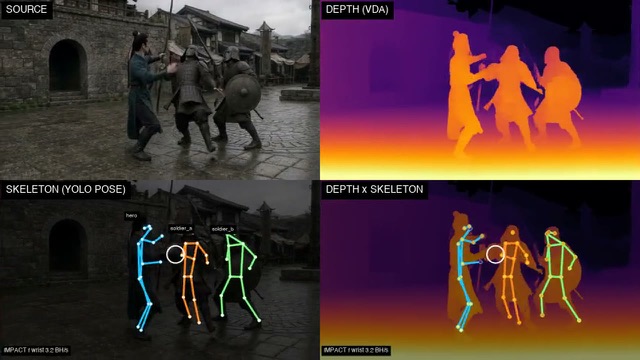
One mark, ten motions

One logo, moved ten ways. Every one lands on the exact shape.

Made with Video Like Peter

Hover to play. Drag to scrub. Click to open.

05 / Decks

One deck skill, four brand languages.

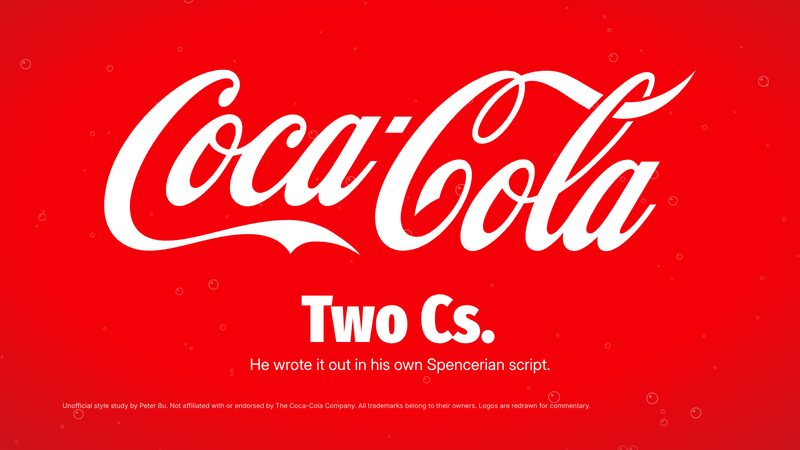
Same skill, four rule books: a keynote, a story told in red, a show in four seasons, and my own company in Trust Blue. Every logo is redrawn in code.

Made with Present Like Peter
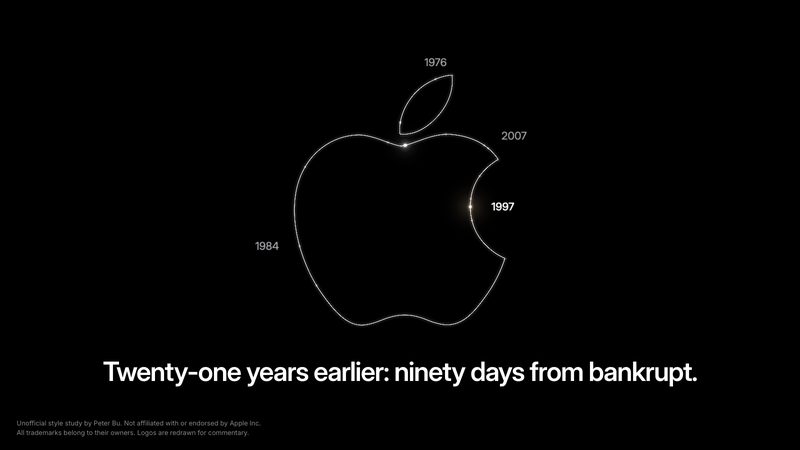
The Apple mark drawn as one line of light on black, with 1976, 1984, 1997 and 2007 placed along its outline, from the Apple style study Unofficial style study

01

Ninety days to a trillion

Apple, as a keynote. One line of light draws the mark.

Open the full deck

The Coca-Cola script, redrawn in code, in white on a red ground with rising bubbles, from the Coca-Cola style study Unofficial style study

02

Recognized in the dark

Coca-Cola, as a story about shape, written by pen.

Open the full deck
Opening frame of the Netflix style study: the red N, redrawn in code, on a black screen, with the unofficial disclaimer Unofficial style study

03

The company that kept canceling its own hit show

Netflix, as a show in four seasons.

Open the full deck
How the four brand languages differ
AppleCoca-ColaNetflixTrustFinance
TypeA quiet grotesk, tracked tight, with a pixel face for 1984.Bold condensed capitals with one script word.Condensed title cards over a clean sans.Poppins, the company's own face.
ColourBlack, paper white and a single blue.A red ground with white type.A black theatre where red is rare.Trust Blue, deep to light.
MotionFades from blur, slow orbits, long silences.Rising fizz, elastic pops and a white ribbon.Hard cuts, sliding rows, two beats and a bloom.The bars of the mark fly in along their own axes and lock.

Unofficial style studies by Peter Bu. Not affiliated with or endorsed by Apple Inc., The Coca-Cola Company or Netflix. Trademarks belong to their owners. Sources: press N inside a deck.

Decks are practice. The next one is live.

06 / TrustFinance

Search any verified license.

Before you choose a financial company, check it: licences, reviews and a TrustScore, free. TrustFinance is my day job.

Acme BrokerDemo

Broker

87TrustScore

4.61,284 reviews

Licence verified, grade A

Sample Markets Authority, DEMO-1042

Companies listed
186,978
Reviews
121,116
Regulators covered
198
Languages
10
Unique visitors
16,015,132

Public counters on trustfinance.com, as of 19 Nov 2026. Founded in 2020.

No code written by hand. So how?

08 / Skills

Daily skills for my work.

Seven AI skills I reach for every day. Each one started as a job I kept doing by hand, until an AI could do it my way.

They were built for me. They are written to work for you.

Learnbe-me

Skill 1 of 7: Be Me

Drafts that sound like you, to that person.

Live proofOne request, three contacts.

RequestAsk for the weekly status

Contact ACloseness 5 of 5

Register
old friend, banter
Address as
no name
Self as
informal first person
Language
Thai
  • one short line at a time
  • no polite particle
  • an occasional joke, never stacked

Draft for Contact ACloseness 5 of 5

อาทิตย์นี้ไปถึงไหนแล้ว เล่าให้ฟังหน่อย

Roughly: where are things at this week? Fill me in.

Shaped byno nameno polite particleone short line

Waiting for your approval.

Contact DCloseness 3 of 5

Register
supportive coaching
Address as
น้อง + nickname
Self as
พี่
Language
Thai
  • reassure first, then ask
  • polite particle on about half the lines
  • praise names the specific progress

Draft for Contact DCloseness 3 of 5

น้อง[ชื่อ]ครับ สัปดาห์นี้งานไหนถึงไหนแล้ว สรุปสั้นๆให้พี่หน่อยนะ
ติดตรงไหนบอกได้เลย เดี๋ยวพี่ช่วย

Roughly: [name], where is each task at this week? Give me a short summary. Stuck anywhere? Just say, and I will help.

Shaped byน้อง + nickname with a polite openerparticle on half the linesoffer to help

Waiting for your approval.

Contact GCloseness 2 of 5

Register
polite, precise
Address as
no name
Self as
none
Language
Thai
  • one polite particle per line
  • one short line
  • defers when unsure: will check and come back

Draft for Contact GCloseness 2 of 5

ขออัปเดตสถานะงานสัปดาห์นี้หน่อยนะครับ

Roughly: may I have this week's status update, please?

Shaped byno name, no greetingone polite particleone precise line

Waiting for your approval.

8 contact cards on the 1 to 5 closeness scale

  1. 5A
  2. 4BC
  3. 3DEF
  4. 2G
  5. 1H

Illustrative personas, not real people.

With and without With the skill 37 of 50, without 24. Without wins on range: five situations against one.

Your voice is measurable and changes by recipient. Learn it from messages you sent, then bend each draft to how you write to that person.

  • about 10,000own messages a profile is learned from
  • 0messages the skill sends by itself
Why and how5 steps

The problem

AI drafts sound like AI: full sentences, a polite particle on every line, the same tone for a co-founder and for HR. People can tell in one line, so every draft gets rewritten by hand.

  1. Export what you wroteYour own sent messages go into one simple JSON shape. A read-only Slack exporter ships; LINE and email adapters are described. The export stays on your machine.
  2. Measure the habitsA standard-library script counts length, particles like ครับ and นะ, line endings, laughter, emoji, Thai and English mixing, regional dialect, and how often you ask versus instruct, globally and per person.
  3. Read before judgingFor every top partner the agent reads a spread of real lines, because a substring match is not a habit. It writes the global voice rules with short pattern evidence.
  4. Score each relationshipEach contact gets a closeness level from 1 formal to 5 intimate, inferred from evidence and then reviewed: how you address them, how you refer to yourself, register, topics, do and avoid.
  5. Draft, never sendAsked for a message, it loads the voice, overlays the recipient's card, keeps unknown facts as placeholders and shows the draft for approval. Sending stays your action.

What it made

In

An illustrative profile (example figures, not a real person)

  • Median message around 20 characters, about half of them one short line.
  • A polite particle on roughly half the lines.
  • Mostly Thai, some English work words, a little English only.
  • Laughter in a small share of messages, dialect only with a few close people.

Out

Same request, three people

  • Closeness 5: one short line, no name, no polite particle.
  • Closeness 3: name plus a polite opener, one softened ask, then an offer to help.
  • Closeness 2: no small talk, one precise line, one polite particle, no jokes.
  • Unknown recipient: neutral polite draft, plus a note that a card is missing.

Learnextract-me

Skill 2 of 7: Extract Me

Your machine already knows what you are good at.

Live proofAll figures come from one scan run.

Scan138 projects36 git repos569 own commits84,935 files53,414 media files128 skills outside plugins3.3 s

Domain score ranks domains, nothing more

  1. Film80.846 projects, 10 skills
  2. Product66.539 projects, 9 deliverables
  3. AI tooling64.15 projects, 6 skills
  4. Motion52.943 projects, 4 skills
  5. Data41.119 projects, 2 skills, 6 deliverables
  6. Strategy16.47 projects, 4 skills, 8 deliverables
  7. Decks7.82 projects, 2 skills, 13 deliverables
  8. Games5.54 projects, 1 skill

Counts files and commits, so single-file decks score low by design.

Strengths open one for its receipts

  1. 01AI film and seriesRuns idea to finished cut as one pipeline.Receipts: 13 final-cut projects, about 10,000 media files in the main series folder, 10 authored film skills
  2. 02Code-rendered motionThree.js, Canvas and Remotion instead of video generation.Receipts: 18 Remotion projects, 2 Three.js films, one 32 minute explainer with 21,000 rendered frames
  3. 03B2B productShips dashboards, consoles and landing pages.Receipts: 10 Next.js repos, top repo 137 own commits
  4. 04Data toolsCollectors, dashboards and audits with traceable numbers.Receipts: a NestJS data platform, a SQLite agent dashboard, a stdlib analyser
  5. 05Agents and skillsTurns solved jobs into reusable Claude skills.Receipts: 25 authored skills, 268 memory notes
  6. 06Decks and strategyExecutive decks and planning packs as single HTML files.Receipts: 13 deck files, 118 HTML deliverables (of 123 loose files)

With and without With the skill 39 of 50, without 27. Without wins on presentation: a readable page against raw JSON.

The proof is already on disk. Scan only the metadata, score it into domains, then make every strength cite the files and counts behind it.

Why and how6 steps

The problem

Every new AI session starts from zero: it does not know you ship motion films, B2B dashboards or executive decks, so it suggests beginner tools and generic plans. Writing that context by hand goes stale within a month and is never backed by proof.

  1. Point it at your workConfirm your git identities and the folders that hold your projects and deliverables. The list is saved so the next refresh is one command.
  2. Scan metadata, never secretsA standard-library script walks the folders in a few seconds: commit counts by author, file types, framework dependencies, README first lines and last activity. Env files, keys, tokens and credential folders are skipped without being opened.
  3. Settle what is really yoursInstalled skills are sorted into authored, not mine and unsure, using symlinks, licences, author fields and vendor-pack prefixes, then checked by reading each one.
  4. Read before judgingScores only rank domains. For each strong domain the agent opens the top evidence, because commit counts undercount agent-built folders full of finished renders.
  5. Write a profile with receiptsPROFILE.md lists strengths each with at least two evidence items, signature methods, active work, working style and blind spots, plus one file per domain. A lint checks headings, paths and leaks.
  6. Every other skill gets personalDeck, video, thinking and idea skills load the profile first, so they start from the methods the person already trusts and skip what is already being built.

What it made

In

One read-only scan of a working machine

Every count in the live proof comes from this one scan of metadata. Env files, keys and tokens are skipped without being opened.

Out

Signature methods it named

  • Single source of truth, then build.
  • Code-rendered over generated.
  • Gate scripts that fail the build.
  • Turn a solved job into a skill.
  • Evidence folders for every claim.

Organiseskill-organiser

Skill 3 of 7: Skill Organiser

A map of every skill, and the edits that make them chain.

Live proofMy real skills folder, mapped in under a second. Names swapped for neutral labels.

174 skills in one folder. Seven of them form two chains.

  • 174 skills
  • 12 handoffs
  • 2 chains

The two chains it found

  1. series-plannerscriptshootfinal-cut
  2. prd-draftprd-publishticket-cards

With and without With the skill 36 of 50, without 31. Without wins on two: spotting look-alike skills, and readability.

Skills already name who they hand off to. Read every SKILL.md as a graph, and the gaps in that graph are the restructure plan.

  • 52proposed edits, 0 applied without a yes
Why and how6 steps

The problem

A skills folder grows one install at a time and nobody draws the map. Two skills claim the same phrase, pipelines live in one author's head, and pointers lead to files that were never written.

  1. Read every skillA standard library Python script walks the skills folder, follows symlinks once, parses each frontmatter and lists every file, reference and script. Plugin caches are optional, with old versions collapsed to the newest.
  2. Draw the edgesEvery line that names another skill becomes an edge, classified as handoff, routes or mentions. A line like plan → script → shoot → edit becomes a pipeline even when a third skill wrote it down.
  3. Find what breaksThe map flags trigger phrases claimed by two skills, descriptions that are near copies, the same name installed twice, orphans, SKILL.md files past 250 lines and pointers to files that do not exist.
  4. Check before claimingText heuristics give leads, not verdicts. The skill opens the real files for each finding and marks it confirmed or false positive before the user sees it.
  5. Propose small editsEach fix gets an id: add a Hands off to or Receives from line, or move one bulky section into references/. Collisions and dead references stay manual.
  6. Apply only on a yesA dry run shows every change. Only ids the user confirms are written, only to SKILL.md files inside the scanned folder, each file is backed up first with a one-line restore, managed skills are skipped and nothing is ever deleted.

What it made

In

A real skills folder

A real skills folder: 174 SKILL.md files, plugins included, across film production, research, product specs, cloud CLIs and thinking tools, some synced from the cloud, some symlinked from other repos, two stale .bak copies.

Out

What the map found (report only, nothing edited)

  • A film pipeline: series-planner → script → shoot → final-cut, but the last hop is only written in the first skill.
  • A product-spec pipeline: prd-draft → prd-publish → ticket-cards, written down only by the last skill.
  • Two skills with identical descriptions under different names (code-review and review).
  • A character-sheet skill pointing at 8 reference files that actually live in another skill.
  • Trigger "character sheet" claimed by two skills; "poke holes in this" claimed by two more.

Makepresent-like-peter

Skill 4 of 7: Present Like Peter

Keynotes built like short films, scored to 9.

Live proofThe deck it built: 7 slides, one 93 KB file.
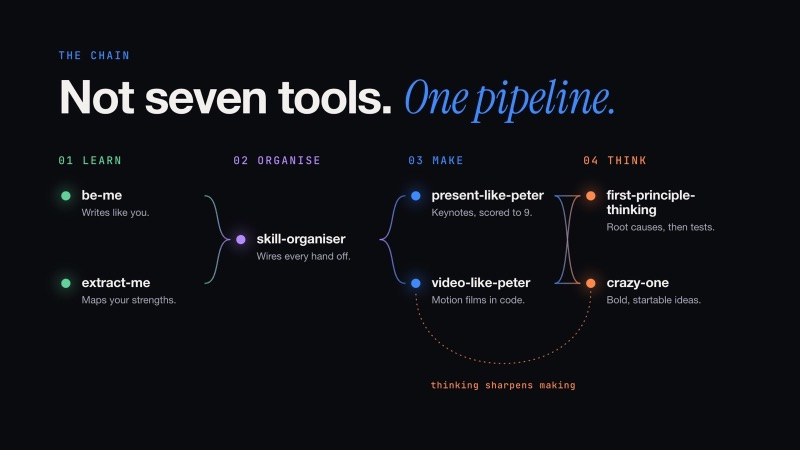
The deck's signature slide: Not seven tools. One pipeline. The seven skills in four families, learn, organise, make and think, with a dotted loop from thinking back to making.

Critic scores, rounds 1 to 3 gate at 9 on every axis

  • Story8, then 9, then 9
  • Wow7, then 8, then 9
  • Accuracy9, then 9, then 9
  • Brand fidelity9, then 9, then 9
  • Legibility8, then 8, then 9
  • Craft8, then 9, then 9
  1. Round 1: Wow 7.
  2. Round 2: Wow 8.
  3. Round 3: all six at 9.

With and without With the skill 43 of 50, without 24. Without wins on file weight only: about 7 KB against 95 KB.

A keynote is a short film driven by a clicker. Write the story first, code the set pieces, and ship nothing scored below 9.

  • 0layout errors at two screen sizes
  • 2engine bugs caught by dogfooding
Why and how6 steps

The problem

Most decks are topics in order on a template: no claim, no moment anyone remembers, and numbers nobody can source. The high-end ones take weeks because the craft lives in one person's head.

  1. Thesis before slidesIt starts with one sentence under 15 words that the audience could repeat tomorrow, then an arc: a cold open with no title, one signature set piece, and a last frame that calls back to the first.
  2. Every number has a source lineEach fact on screen gets a line in a research file with its source and the date it was checked. Anything marked VERIFY stays off the slides, and the sources ride along in the speaker notes.
  3. One offline file, drawn in codeSlides are built on one shared engine: a 1920 by 1080 stage, build steps, keyboard and click control, deep links to any slide and step, notes, autoplay, reduced motion and print mode. Set pieces are canvas or Three.js scenes, fonts are inlined, and nothing loads from the network.
  4. A script that looks for troubleA headless browser shoots every slide at 1920 by 1080 and 1280 by 720, flags text beyond the stage, overflowing cards, overlapping text, small type, console errors and network requests, then builds a contact sheet for a human eye.
  5. A critic with a gateA fresh pass scores story, wow, accuracy, brand fidelity, legibility and craft from the contact sheet alone, with evidence per slide. Anything under 9 sends the deck back to build, up to three rounds.
  6. Export without losing the masterPrint mode turns every slide into a vector PDF page, each slide becomes a 2x PNG, and an image PPTX carries the speaker notes. The HTML stays the version that moves.

What it made

In

The brief for the dogfood run

Present the seven new skills (be-me, extract-me, skill-organiser, present-like-peter, video-like-peter, first-principle-thinking, crazy-one) to portfolio visitors in about three minutes on autoplay, in the site's own palette. Thesis: your best work already holds its own instructions; seven skills read them back.

Out

What the run produced
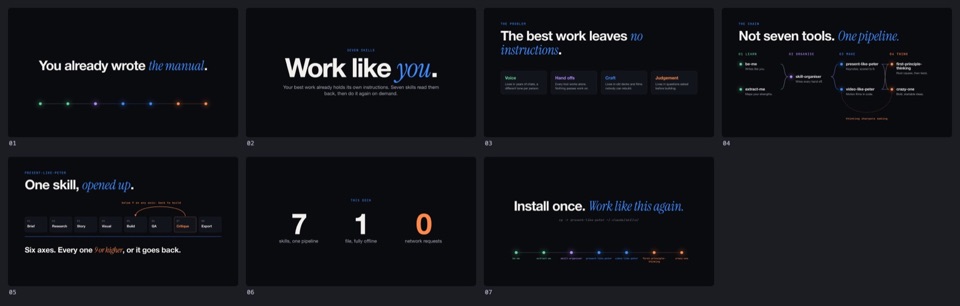
  • Cold open: 300 fragments of work gather into seven colour points.
  • Signature slide: the seven skills light up family by family as one pipeline, with a loop from thinking back to making.
  • Callback end: the seven points from the opening return with the skills' names.
  • Exports: a 7 page PDF and a 7 slide PPTX with speaker notes.
All seven slides of the deck it built, in order, from the cold open to the install slide
All seven slides, from the contact sheet its QA script makes.

The three rounds

  1. Round 1: four axes under 9, lowest Wow 7. The signature slide's handoffs were thin grey lines, so the pipeline was told, not shown. Fixed: brighter, thicker lines in the family colours.
  2. Round 2: two axes under 9, lowest Wow 8. The last slide repeated the opening's seven unnamed dots. Fixed: each dot now names its skill.
  3. Round 3: all six at 9, so the gate opened.

Who scored it: a separate pass that saw only the contact sheet, the seven stills and the story, with evidence per slide. It was the builder agent itself, as no fresh agent could run in that session.

Makevideo-like-peter

Skill 5 of 7: Video Like Peter

References first, then a film written in code.

Live proofThe card it built: 6 seconds, 180 frames, 0.5 MB.

With and without With the skill 38 of 50, without 26. Without wins on the loop: it fades back to its first frame.

Measure the references instead of describing them, then render every frame as a pure function of time, so the film lands where the storyboard says.

  • 22reference candidates from 3 searches
  • 0.57 smedian shot of the fast reference, measured
Why and how6 steps

The problem

Motion made straight from a prompt moves a lot and says little, and AI video smears the type. The good films start on paper: references, a beat grid, a board people can review.

  1. HuntSearch YouTube with style words, not topic words. Three queries gave 22 candidates; two were picked, one fast and one slow.
  2. MeasureA script pulls a small copy, counts cuts, reads the palette, keeps 320 px frames and a contact sheet, then deletes the video.
  3. Steal and leaveEach reference gets four steal lines (pacing, transitions, type, colour) and one leave line, specific enough to storyboard.
  4. StoryboardShots on a 120 BPM grid with landing times, copy and the stolen idea, turned into one HTML frame board that works before any code exists.
  5. Build in codeThree.js stages Canvas-painted type with real motion blur. A determinism check proves every frame is a pure function of time.
  6. Look and deliverContact sheets after every change, real frames swap into the board, then the master renders frame by frame and ships with its board.

What it made

In

The brief

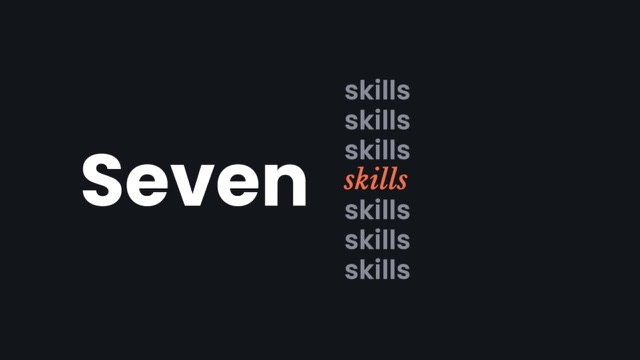
A 6 second kinetic title card that says "Seven skills", 1280x720, 30 fps, silent loop for a portfolio page.

Out

What the run produced

  • storyboard.html: reference board, timeline and frame board in one file.
  • A steal list: a repeated word stacked seven times with one row in the accent, one field change on the bar line, a lockup that holds 2.5 s.
  • contact-sheet.jpg: two frames per second of the final render.

Thinkfirst-principle-thinking

Skill 6 of 7: First Principles Thinking

Question every assumption, rebuild from what is true.

Live proofRun on one question: why do AI decks all look the same?

  1. A1ReleasedconventionA deck is a stack of separate 16:9 rectangles.
  2. A2ReleasedconventionEach slide is a title plus 3 to 5 bullets.
  3. A3ReleasedhabitText is the content; visuals decorate.
  4. A4ReleasedconventionBrand means logo in the corner plus palette.
  5. A5ReleasedhabitEvery slide must carry information.
  6. A6ReleasedhabitTransitions are decoration.
  7. A7ReleasedconventionOne design system holds first to last.
  8. A8ReleasedconventionStory order equals agenda order.
  9. A9ReleasedhabitNeutral, safe design is professional.
  10. A10Keptphysics (in part)The audience reads the slides.
  11. A11KeptphysicsAttention goes to one thing at a time.
  12. A12Keptphysics (well replicated)Peaks and the ending are remembered.
  13. A13KeptdataFacts must be verifiable.
  14. A14ReleasedhabitA topic is enough of a brief.
  15. A15ReleasedhabitRestraint is safer than boldness.

Seven true statements, with no solution words in them

  1. C1Attention is serial: one focal thing per moment.
  2. C2People keep a few peaks and the ending.
  3. C3Words on screen and words spoken compete.
  4. C4Recognition comes before reading (colour, type, motion in the first seconds).
  5. C5Every claim traceable to a source.
  6. C6Novelty is relative to what the audience has seen.
  7. C7A drawn visual is now nearly free, so the cost case for templates is gone.

Four hypotheses, cheapest first

  1. H1The brief causes the sameness, not the tool.Test: one tool, same topic, topic-only vs constraint brief, count shared template features.20 minutes. Kill if counts within 20%.Run first
  2. H2Viewers judge "template" within 5 seconds.Test: 5 people, first 5 seconds of 4 decks.30 minutes. Kill if fewer than 4 of 5 separate them.
  3. H3One idea per frame raises recall.Test: bullet vs one-word version, 3 facts next day.1 hour + 1 day. Kill if difference under 1 fact.
  4. H4A signature seed in the first 5 seconds keeps people watching.Test: embedded autoplay watch time, cold open vs title open.1 week. Kill if no difference in median.

With and without With the skill 40 of 50, without 28. Without wins on readability, for someone new to the problem.

Tag every assumption as physics, data, convention or habit. Only physics and data survive, so what is left forces an answer nobody else reaches.

Why and how6 steps

The problem

Most plans copy how everyone else already does it, so nobody can say why the work looks the way it does. When the starting point is a template, the result is the average of every template before it.

  1. Restate the problemOne sentence about the outcome wanted, with every tool and format word removed, plus the decision it will inform.
  2. List and tag assumptionsWrite down everything the current way takes for granted and tag each one: physics, data, convention or habit. Data must name its source.
  3. Climb the question ladderFor each convention and habit ask why, what is actually true, and what would have to be true. Each one is grounded or released, with a note on what it was protecting.
  4. Reduce to constraintsThe survivors become a short list of true statements about the world, with no solution words in them.
  5. Rebuild from scratchThree or more answers built only from those constraints, including one that convention would reject. Every part must serve a constraint or be named as taste.
  6. Test the cheapest thing firstThe chosen answer becomes falsifiable hypotheses, each with a test, a cost and a kill criterion, ordered so the first can run today.

What it made

In

The question it was run on

Why do AI-generated slide decks all look the same, and what would a deck look like if built from first principles? Evidence: the build briefs behind three brand history decks, including a reviewer's note that round one was elegant, correct and quiet to a fault.

Out

What came back

  • Root cause: the brief leaves every design decision open, and an open decision gets filled with the most probable answer, which is the old document template.
  • The unit of design is the slide, not the moment, so nothing asks what the audience should feel at each point.
  • Even a carefully built deck inherited one untested habit (restraint as safety) and came out quiet.
  • Rebuild: one idea for the whole deck, one continuous world, one signature moment, a callback ending, a design language that changes with the story.

Thinkcrazy-one

Skill 7 of 7: Crazy One

Break the assumptions a plan never questions.

Live proofRun on a 1,085 line build brief, on the bold dial.

The bets it kept Pick one.

5 killed for harm, deception or invented facts

K1constraint flipBet 1

The blind test: guess the brand before the title.

Impact 5, feasibility 5, reversibility 5, crazy 4

With and without With the skill 42 of 50, without 27. Without wins on scanning speed. It also saw only an excerpt of the brief.

Crazy ideas come from breaking a plan's sacred assumptions on purpose. Find those first, then keep only the breaks that do good and start tomorrow.

  • 9sacred assumptions found in the brief
Why and how5 steps

The problem

Brainstorms usually tweak a plan instead of challenging it, because nobody names what the plan takes for granted. The wild ideas that do appear are either unsafe or impossible to start this week.

  1. Frame the documentIt reads the whole document and writes down the real goal behind the stated one, the audience, the hard and soft constraints, and at least five sacred assumptions, each pointing back to the line it came from.
  2. Pull eight leversInvert, 10x, delete the core, steal from another industry, make it free, make the customer do it, time travel ten years, constraint flip. Each operator is aimed at a specific assumption, with a quota set by the dial: sane, bold or unhinged.
  3. Kill what hurtsEvery idea faces a kill list: harm, deception, rights, invented facts and the owner's own never rules. Killed ideas stay visible with their reason, so you see what was considered.
  4. Score four waysImpact on the real goal, feasibility, reversibility and craziness, ranked by impact times feasibility. Gates keep the top picks both bold and undoable.
  5. Hand back three betsThree crazy but doable bets and one wildcard, each with a first step one person can do in under a day without spending or publishing anything, a signal to keep going, and a way to undo it.

What it made

In

The build brief for three brand-history decks

One presentation skill builds three decks from one structure brief and one engine. Only the brand language changes. ... No logo files and no logo shapes. Every visual is drawn in code.

Out

Top bets from the bold dial

  • The blind test: show one frame and let the visitor guess the brand before the title appears, so the no-logos rule becomes the proof instead of a disclaimer.
  • The director's commentary: press C and every frame names the rule in the brief that produced it, so the page sells the judgement, not just the output.
  • Skin as data, then swap: brand languages become files, and the same story replays in another brand's grammar, nine combinations from one engine.
  • Wildcard: one timeline, three companies, a single film where the design language changes as the camera crosses each company's years.

All seven

Seven jobs I no longer do by hand.

Same brief, same model, run twice: once with the skill, once without.

  1. Present Like Peter 24 without, 43 with the skill, +19
  2. Crazy One 27 without, 42 with the skill, +15
  3. Be Me 24 without, 37 with the skill, +13
  4. Extract Me 27 without, 39 with the skill, +12
  5. First Principles Thinking 28 without, 40 with the skill, +12
  6. Video Like Peter 26 without, 38 with the skill, +12
  7. Skill Organiser 31 without, 36 with the skill, +5

275 of 350 with the skill. 187 without. The skill won all seven, by 5 to 19 points. In six of the seven, the run without the skill still scored higher on at least one thing. Each chapter says which.

All seven are public. Install them where you work.

github.com/opelpleple/peter-skills